This week’s research roundup is all about adaptation: how the brain updates behaviour when the rules change, how developing bodies can thrive on different eating patterns (with the right planning), and how tiny changes in neural “wiring” can alter the way information travels. Here are four studies worth knowing, plus a simple daily support pick at the end.
1) The brain’s “disappointment signal” that helps you break habits
Ever notice how one unexpected let-down can jolt you into changing your approach? In a new study, researchers explored what happens in the brain when a previously reliable reward suddenly disappears, and what helps animals stop repeating the same choice.
Mice were trained to navigate a virtual maze to earn a reward. Then the “correct” route was switched, meaning the expected reward didn’t arrive. The researchers watched neurotransmitter activity in real time and found a noticeable surge in acetylcholine release in key brain regions right after the non-reward moment, essentially, a chemical “update signal” that something has changed.
What’s especially interesting: the bigger the acetylcholine increase, the more likely the mice were to switch their next choice (“lose-shift” behaviour). When researchers reduced acetylcholine production, this flexible switching dropped, suggesting acetylcholine plays a central role in interrupting autopilot behaviour and enabling new learning when circumstances change.
Why it matters: Whether it’s changing routines, breaking unhelpful habits, or adapting to new demands, behavioural flexibility is a cornerstone of healthy cognition. This study helps explain how the brain flags “old rules no longer apply” - and how it nudges you toward a new strategy.
Takeaway: Unexpected outcomes aren’t just frustrating, they can be information. Your brain has dedicated chemistry for noticing change and helping you pivot.
2) Plant-based diets and children: healthy growth is possible, but planning matters
A major review and meta-analysis looked at whether vegetarian and vegan diets can support healthy growth in children and adolescents, and where the nutritional pressure points tend to be.
Researchers reviewed evidence from 59 studies across 18 countries, including data from over 48,000 young people. They compared omnivorous diets with lacto-ovo-vegetarian patterns (including dairy and eggs) and vegan patterns (excluding all animal-derived foods). Their overall conclusion: well-planned vegetarian and vegan diets can support normal development, but nutrient shortfalls can arise when key nutrients aren’t consistently supplied via fortified foods or supplements.
Across the data, vegetarian children tended to consume more fibre, iron, folate, vitamin C, and magnesium, but often had lower intakes of total energy, protein, fat, zinc, and some B vitamins. In vegan children (fewer studies available), the same pattern showed up with a stronger emphasis on nutrients like vitamin B12 (notably hard to reach without fortification or supplementation), and often calcium, iodine, and zinc trending low.
The review also noted potential upsides: plant-based groups often showed more favourable cardiovascular markers (like lower total and LDL cholesterol) and tended to be leaner on average. The authors emphasised that families shouldn’t be discouraged, just supported with clear guidance, especially during periods of rapid growth.
Why it matters: A plant-based approach can absolutely work for kids, but “plant-based” isn’t automatically “nutrient-complete”. Thoughtful planning is the difference between thriving and quietly missing essentials.
Takeaway: For families choosing vegetarian or vegan patterns, the winning formula is simple: intentional planning + smart fortification/supplementation + regular check-ins.
3) Losing a small segment of myelin can scramble long-distance signalling
Myelin (the protective coating around nerve fibres) is famous for speeding up signal transmission. But a study suggests its role can be even more specific: losing a small, strategic segment of myelin near the nerve cell body may change how information is encoded and recognised downstream.
Researchers looked at a communication pathway between the cerebral cortex and the thalamus (a deep brain relay centre) that supports ongoing “back-and-forth” signalling. When they induced myelin degradation, they expected widespread loss along the nerve fibre, but instead, the damage occurred mainly in regions closest to the cell body.
The result: signals travelling to the thalamus became slower and less consistent - and, crucially, the first wave of signals was lost entirely. The team compared it to scanning a barcode: if the first stripe is missing, the scanner can’t read the product correctly. In behavioural terms, mice could still detect contact with their whiskers, but the brain’s timing and precision in identifying “when and what” was reduced.
Why it matters: This highlights myelin as more than insulation, it can shape the brain’s timing codes and the reliability of communication loops.
Takeaway: Small changes to neural “wiring” can have outsized effects on how information is transmitted, timed, and interpreted.
4) Your brain’s internal GPS: how it tracks distance in the dark
You can walk through your home at night without switching on the lights because your brain is constantly estimating where you are based on your movement. This skill is called path integration, and scientists are now unpacking the neural code behind it.
In a virtual reality setup with minimal visual cues, mice learned to run a specific distance to earn a reward, relying on internal movement tracking rather than landmarks. Researchers recorded activity across thousands of hippocampal neurons (a region deeply involved in navigation and memory processing) and found that most cells followed one of two “ramping” patterns.
One group of neurons fired strongly at movement onset, then gradually decreased activity at different rates as distance progressed. Another group did the opposite: activity dipped at the start, then ramped up as the mouse travelled farther. Together, these patterns created a code that could represent both distance and elapsed time, using different ramping speeds for different travel demands. When the team disrupted the circuits that produce these patterns, the mice struggled to judge where the reward should be.
Why it matters: This gives a clearer picture of how the brain builds a moment-by-moment map of movement, not just through “place cells,” but through dynamic activity patterns that count distance and time.
Takeaway: Your sense of “where am I?” is built from multiple layers of brain coding, including ramping signals that function like an internal odometer.
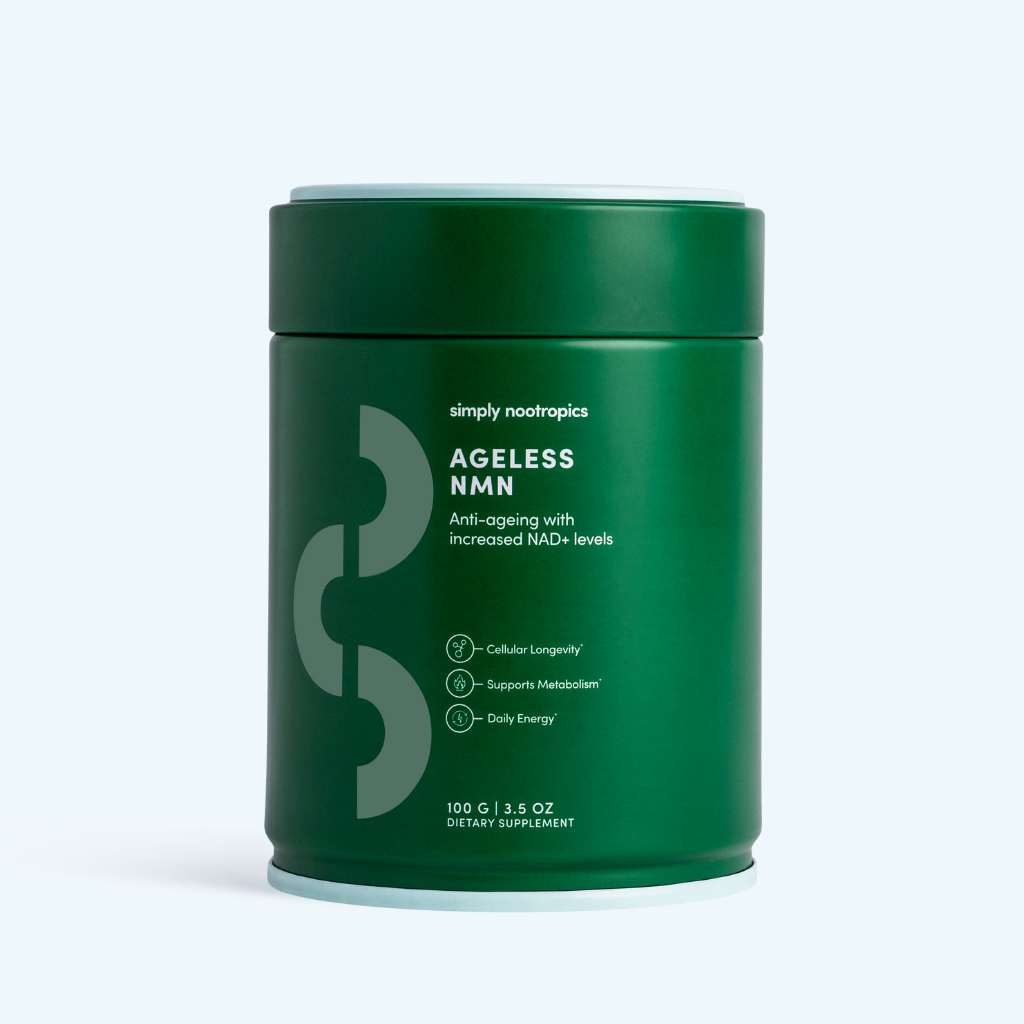
Product spotlight: Ageless NMN
When weeks get busy, the goal isn’t to “push harder”, it’s to support the systems that help you feel steady in the first place. Ageless NMN is Simply Nootropics’ go-to for supporting your cellular energy baseline, by providing NMN - a building block your body uses in pathways linked to everyday energy production and healthy ageing.
It’s an easy daily addition when you want to feel more consistent (especially through high-demand periods like end-of-year schedules), because it works best as a routine, not a last-minute fix. If you’re looking for one foundational product to keep in your stack while life gets full, Ageless NMN is a simple place to start.