Most people think of sleep as the thing that happens when the day ends. You close your eyes, your body shuts down, and you wake up ready to go again. But sleep is far from passive. While you rest, your brain is running one of its most complex and critical maintenance programmes, and the quality of that programme has a direct, measurable impact on your mental health.
The connection between sleep and mental health is not a soft, lifestyle-magazine claim. It is one of the most well-established relationships in neuroscience. And yet most people still treat sleep as the last priority, the first thing to sacrifice, and the least interesting part of their sleep wellness routine.
That is a mistake worth understanding.
What Actually Happens When You Sleep
Sleep happens in cycles, each lasting roughly 90 minutes, and each cycle contains distinct stages: light sleep, deep sleep, and REM (rapid eye movement) sleep. Every stage serves a different function, and skipping any of them, even unintentionally, carries a cost.
Deep sleep is where physical restoration happens. Your body repairs tissue, consolidates the immune system, and releases growth hormone. But deep sleep also plays a critical role in emotional regulation. Research has shown that deep sleep helps process and neutralise the emotional charge of difficult experiences, effectively reducing the intensity of negative memories overnight.
REM sleep is where your brain gets busy. This is the stage most associated with dreaming, but its function goes well beyond narrative. During REM, your brain processes the emotional content of your day, consolidates learning and memory, and essentially performs a kind of overnight therapy, integrating new information, filing experiences, and preparing you to face tomorrow with a clearer emotional baseline.
When you cut sleep short, you disproportionately lose REM. And when you lose REM, you lose that processing capacity.
The Mental Health Cost of Poor Sleep
The mental health consequences of disrupted sleep are not subtle. Even a single night of poor sleep measurably increases anxiety, reduces emotional resilience, and impairs the prefrontal cortex, the part of your brain responsible for rational thinking, impulse control, and decision-making.
Over time, chronic sleep disruption is strongly associated with depression, anxiety disorders, and increased emotional reactivity. Studies have found that people with insomnia are ten times more likely to develop depression and seventeen times more likely to develop anxiety than people who sleep well.
The relationship runs in both directions. Poor mental health disrupts sleep. Poor sleep worsens mental health. Breaking the cycle requires addressing both sides, but sleep is often the more actionable lever.
Cortisol, Melatonin, and the Hormonal Picture
Sleep is not just a behaviour. It is a hormonal event, and the hormones involved have a direct line to your mental state.
Melatonin is the key regulator. Produced by the pineal gland in response to darkness, melatonin signals to the body that it is time to wind down. It does not cause sleep directly, it creates the conditions for it. Disruptions to melatonin production, whether from artificial light, irregular schedules, or stress, push sleep later and reduce its quality.
Cortisol, your primary stress hormone, follows an opposite rhythm. It should be lowest at night and peak in the early morning to help you wake up. When sleep is poor, this rhythm breaks down: cortisol stays elevated into the evening, keeping the nervous system activated when it should be winding down, and creating a feedback loop of stress and sleeplessness that compounds over time.
Serotonin is another key player. About 95% of the body's serotonin is produced in the gut, but the brain's serotonin pathways are heavily dependent on sleep for regulation. Low serotonin is closely linked to depression and anxiety, and poor sleep consistently suppresses serotonin activity.
The Role of GABA
One of the most important but least discussed compounds in sleep science is GABA (gamma-aminobutyric acid). GABA is the brain's primary inhibitory neurotransmitter: essentially, it is the signal that tells your nervous system to slow down.
Low GABA activity is associated with anxiety, insomnia, and mood disorders. During healthy sleep, GABA activity increases significantly, helping to quiet the mental chatter, reduce nervous system activation, and allow the brain to transition into deeper stages of sleep. Supporting GABA function is one of the most targeted approaches to improving both sleep quality and emotional resilience.
Sleep Debt Is Real - and It Compounds
There is a common belief that you can catch up on sleep at the weekend. The research does not support this. While an extra hour or two on a Saturday can partially offset acute sleep loss, the cognitive and emotional deficits of chronic sleep deprivation do not fully reverse with occasional recovery sleep.
Sleep debt is cumulative. Each night of insufficient sleep adds to a deficit that impairs mood, cognition, and stress tolerance, even when you feel like you have adapted. Studies on chronic sleep restriction consistently show that people significantly underestimate how impaired they are, because their baseline has shifted.
How to Actually Improve Your Sleep
Improving sleep quality requires more than going to bed earlier. The most evidence-backed approaches include:
-
Keeping a consistent sleep and wake time, even on weekends, to anchor your circadian rhythm.
-
Reducing light exposure in the two hours before bed, particularly blue light from screens, to support natural melatonin production.
-
Keeping your bedroom cool: body temperature drops as part of the sleep onset process, and a cooler room supports that transition.
-
Avoiding alcohol close to bedtime, which fragments sleep architecture and suppresses REM despite its sedative effect.
-
Managing stress actively during the day, since cortisol that builds up during waking hours does not simply disappear at bedtime.
Genius Sleep and the Science Behind It
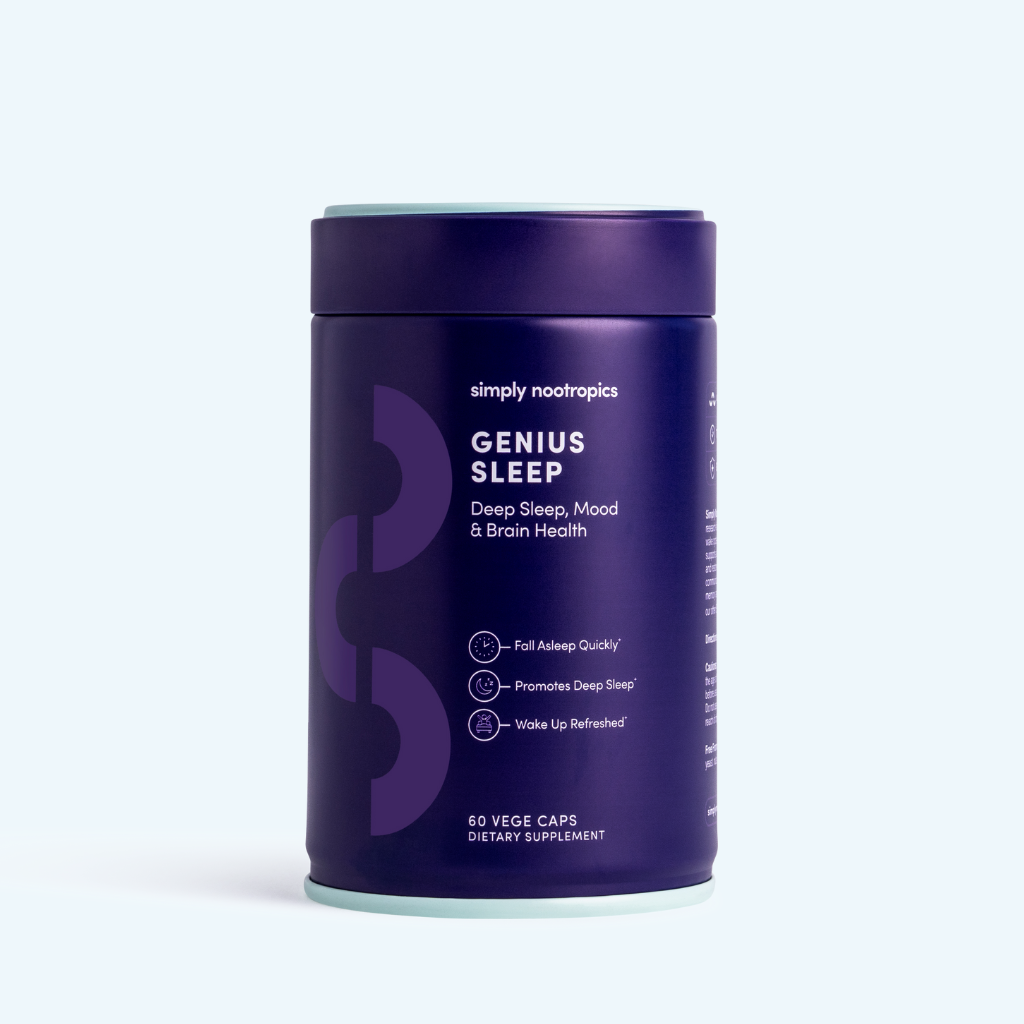
Genius Sleep was formulated to support the biological conditions that make quality sleep possible. It contains magnesium bisglycinate, a highly bioavailable form of magnesium that supports GABA function and helps regulate the nervous system in the lead-up to sleep. It includes L-theanine, an amino acid that promotes calm alertness and eases the transition into sleep without sedation.
Alongside these, Genius Sleep includes ingredients specifically chosen to support melatonin regulation and REM sleep quality, making it a comprehensive approach rather than a single-ingredient sleep aid.
For anyone whose sleep is being disrupted by stress, cortisol, or a racing mind, Genius Sleep is designed to work with your body's natural sleep architecture, not override it.